Francisco Ayala is a distinguished scientist and thinker, who left religious life to pursue science. His views on science and religion are worth hearing.
Kudos to Reason.TV for venturing beyond pure political philosophy and policy.
I can't help but take this opportunity to contrast the rather gentle Ayala with someone like Richard Dawkins, whose intellect I greatly respect, but not his manners. Ayala and Dawkins agree on some things in fact.
But one of Dawkins' greatest failings is toward his own stated objectives. He tries to accomplish several things with only one shotgun approach.
While he rightly challenges superstition and persecution of atheists with vigor, his own acid intolerance of religion and religious people undercuts the objective of his foundation, which is to "[s]upport the scientific education, critical thinking and evidence-based understanding of the natural world in the quest to overcome religious fundamentalism, superstition, intolerance and human suffering."
(Philosophical note: Dawkins goes beyond "methodological naturalism" which many scientists practice, including Ayala -- meaning not injecting God into a scientific inquiry ("creation science") so as to poison it -- to assert the non-existence of God. This is known as "metaphysical naturalism," and is not a scientific position, but a metaphysical one.)
Why should one embrace a life of science and reason if it means acting like Richard Dawkins all the time? He is not a model of reason himself. At least not in anything other than the classroom or laboratory practice of science. Where is the element of "humanity" and "meaning" in his approach? Is that part of reason? Scientific or otherwise? Perhaps, as Ayala notes, these are the purview of religion? Perish the thought . . .
Monday, July 19, 2010

Friday, July 16, 2010
Borrowing from Venezuela: One, Two, Three Strikes, You're Out!

The now-viral slogan appears on banners, signs, t-shirts and at baseball games everywhere in Venezuela, protesting the blustering and incompetence of Chavez's "reforms" against the evil bourgeoisie. (Well, maybe not appearing at the home of a businessman on the run, where Chavez's client-looters are happily eating in the kitchen or taking a dip in the swimming pool.)
I think a similar slogan should be applied to Mr. Obama and his party.
As Kimberly Strassel notes in yesterday's Wall Street Journal, after the so-called mainstream media touted Mr. Obama's third major legislative "victory": "There's no longer any question whether this White House can close a sale. Its problem is the country doesn't like what it's selling."
The most recent "finance reform" is an example of looting, exploiting a crisis to make it easier for unions and activists, for example, to crash corporate boards. Which has what to do, exactly, with reforming banking and Wall Street?

I think it's time we in the public coin a similar slogan for our friends in the Democrat Party ("Dem Bums"?), and Mr. Obama in particular, perhaps soon to appear on a t-shirt or at a local baseball game near you: "Stimulus, Healthcare, Banks, You're Out!"
Wednesday, July 14, 2010
Policy Group and Obama Administration to "Reform" the Media on the Model of Venezuela?
The Obama administration has many policy pots on the stove. Perhaps too many to be effective. However, bubbling up are some truly radical notions, such as involving government heavily in the "management" of the media, threatening the First Amendment. This, modeled on the "policies" of Hugo Chavez, if you can believe it!
Apparently Sean Penn, Woody Allen and Oliver Stone are not alone in their admiration of the Venezuelan buffoon/strongman.
The Technology Liberation Front's Adam Thierer provides the details.
It's truly disturbing, and maddening how leftist policy "experts" relentlessly attempt to impose their visions on the rest of us, ignoring the wisdom of our Constitution, and the evidence of reality.
Apparently Sean Penn, Woody Allen and Oliver Stone are not alone in their admiration of the Venezuelan buffoon/strongman.
The Technology Liberation Front's Adam Thierer provides the details.
It's truly disturbing, and maddening how leftist policy "experts" relentlessly attempt to impose their visions on the rest of us, ignoring the wisdom of our Constitution, and the evidence of reality.
Tuesday, July 6, 2010
Stone's Film is a Sign of a Deep-Seated Tyrannical Temperament

In "The Republic
 ," Plato provides some wonderful insight into the origins of tyranny. He distrusted "the mob" or mass of humanity because, he argued, they will seek to organize society around base needs, and not important philosophical principles such as justice and truth. When the so-called champion of the people demands unlimited power to protect his holy mission on behalf of the mob, the nation's fate is sealed.
 This lesson plays out again and again in nation after nation. We see it today in dramatic fashion in places such as Russia and Venezuela, where buffoons and thugs, running the country in the name of "the people," do quite nicely for themselves while oppressing their enemies. This is the very essence of the false notion of "justice" offered by the Sophists in the first books of "The Republic."
Yet, time and again, people ignore this lesson. Lured by personal insecurity and pessimism, and emergencies real and manufactured, people sacrifice their own freedom and protection, under a republican system of laws, in favor a "strong man" with alleged insight into the "real nature" of the emergency, and the force of will to do something about it.
The paradox is that no one man can know enough about any political or economic problem to "solve" it. Often the dictator's solutions boil down to nothing more than the imposition of his personal whim in response to his own fantastical imaginings, buttressed by masterful demagoguery.
People may not like to hear this, but Barack Obama is a smaller version of such a creature. Observe his natural tendencies of demagoguery and his clueless imaginings about the roots of our economic problems. His answer to almost every problem is more of him and his fellow travelers, the economic illiterates Pelosi and Reid.
Paradoxically, the proper answer, is, of course, more of others. Not the Republican party, with the likes of dangerous attention-cravers such as Rove and Boehner and Gingrich. The answer is more freedom. More unleashing of the genius of the people to solve their own problems.
Obama's demagogic bellowing (about banks and other corporations - whom he negotiates deals with in secret because no one man can solve all problems) is restrained somewhat by the bars of the Constitution. A constitution he has shown himself -- like presidents before him -- willing to ignore or circumvent when he can.
He will not get to take power the way he thinks he deserves. But with each assault on the restraints on power by the constitution, (in his case by seizure of auto company assets, by health care mandate, by presidential "compensation funds") the bars weaken a little more. Setting the stage for a little more tyranny until (dare we suggest it in polite society???) the bars break.
Blindness to subtle changes in the constitution of freedom are somewhat understandable. As economists in the "public choice" school have observed, we often are distracted by other activities and incentives when slow encroachments on liberty take place.
This is a serious problem, captured in the political imaginations of many diverse authors, from Thomas Jefferson to Ayn Rand. To which there is no answer but a proper kind of sacrifice of those who would not seek power for themselves.
But, returning to my original point, how do you explain apologists for tyrants, such as Oliver Stone? His latest film, lauding Latin American dictatorship, makes one wonder about the problem of hardened paradigms. Amidst the most basic evidence about Chavez's mendacity and stupidity it is amazing how tightly some can cling to the paradigm of the "strong man."
A projection of their own insecurity, perhaps, even as they occupy positions of some modest influence over society.
Perhaps Mr. Stone, with more respect for the genius of his own film-making community, should go back and watch Chaplin's classic "Great Dictator
 " and other such films to clear his head a little. (Wikipedia entry here.)
 More eloquent treatises have been written about this secondary problem of tyranny than mine. My only point is to note that dictators do not thrive without their foolish supporters. And as we see from Stone's latest piece of propaganda, the tyrannical temperament remains deeply and powerfully rooted in many places, even in so-called "free societies."
Friday, July 2, 2010
The Expand My Horizons Reading List
My belief system has undergone dramatic shifts and challenges over the years. I find myself puzzling over certain questions, and have noted some areas where I feel the need to expand my knowledge.
1. Evolution. What is
1. Evolution. What is
Sunday, June 27, 2010
One Man's Trial, and Gratitude for Life

I wish the Skunk well in his recovery.
Friday, June 25, 2010
A Week to Use in Weeks Ahead
It seems the older I get the more life oscillates rapidly between light and darkness. I don't mean that it all happens to me, or that it all occurs in the same degree, but rather I simply observe, and hear about, and am provoked by so much more.
On my birthday, friends leave kind wishes with charitable hopes, at the same time that I am of necessity doing some of the most backbreaking and psychologically challenging work I have ever done -- in intense heat.
A successful musician I admire and correspond with socially undergoes brain surgery, calling forth images of my own late mother's similar procedure, while the same day a good friend endorses me most generously to his former employer; veritable gold in a time of some scarcity of opportunity.
The week overall brings reports from friends of great successes, and also revelations of deep cynicism. At home my family receive regularly sequenced acts of generosity from siblings, aunts, uncles and in-laws, and serendipitous kindness from strangers. Sometimes these displace moments of self-doubt. Sometimes they evoke new ones.
My children bring joy, and contemplation of their development and their natural beauty.
But also there is weariness, and sadness. Weltschmertz even.
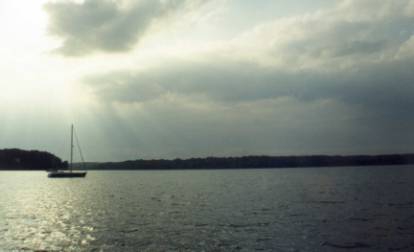
One day this week I sat on a dock in Lloyd Harbor, overlooking a magnificently beautiful vista of rippling waters and anchored sailboats. Based on all past experience I should have enjoyed it deeply. But, beaten down by fatigue, no matter which way I looked on that water, all I could feel was what I was missing. There was no consolation or contemplation. I simply hoped to cool off my body a bit before stumbling back up the hill to work for several more hours in the heat. Feeling more than my age and more than a little off course from the destiny that seemed so clearly plotted in my youth. "Where is that benevolent, guiding force?" I wondered. Is it more subtle and sublime than I can imagine? Was it ever there?
Yet as all the impressions of these moments drift into the past and settle down in the memory, with the passage of time, they are refined into the raw material of "experience." To fuel the soul through another day, or week, or year to follow.
With hope, those will be better ones. But hopes like these have been had before.
Subscribe to:
Posts (Atom)